Overview
ClearSignal is a mobile-first care-coordination prototype for Parkinson’s families: daily check-ins, sudden-change alerts, a hospital card, and a short care timeline. The walkthrough below is the post-research product.
I explored a broad set of Parkinson’s care challenges, narrowed them to an actionable unmet need, then tested and reshaped a care-coordination concept with caregivers.
ClearSignal is a mobile-first care-coordination prototype for Parkinson’s families: daily check-ins, sudden-change alerts, a hospital card, and a short care timeline. The walkthrough below is the post-research product.
I started with qualitative social listening on Reddit—an AI-assisted summary of community discourse plus hand-selected posts from people living with Parkinson’s and their caregivers. This is community-sourced insight, not clinical research.
Patient perspective: sudden decline, loneliness, exercise, voice changes.
Burnout, end-stage decisions, rapid decline, swallowing safety.
Hospital guides, medication side effects, young-onset PD, app usage.
“No sudden changes with Parkinson’s. The most common is infection (UTI) or Stroke. This is one time to get him to an Emergency room.” — r/Parkinsons
“Everyone with Parkinson’s should get the FREE Hospital Safety Guide from the Parkinson’s Foundation.” — r/Parkinsons
UTIs and infections mimic progression; families often act too late.
Med errors, levodopa holds, and missing neurologist context in crises.
Constant monitoring and crisis decisions without a shared log.
Tremor/mood tools exist; acute infection and sudden-change workflows do not.
Exercise helps but PD is lonely; hard to sustain without structure.
Voice changes precede mobility issues; SLP referral often comes late.
Six themes became three product directions. I compared them against unmet need, engineering complexity, overlap with existing tools, regulatory risk, and what I could realistically prototype as a solo designer.
Exercise & social hub—boxing, gait work, buddy matching, on-period scheduling.
Infection & sudden-change alert system—check-in, caregiver alerts, hospital card, timeline.
Early speech & swallow coach—drills, checklists, SLP referral prompts.
Excerpt from the concept evaluation—criteria that decided which direction to prototype.
| Criterion | SteadyPath | ClearSignal | VoiceFirst PD |
|---|---|---|---|
| Solo designer feasibility | Medium (content + community) | High (flows & IA) | Medium (audio/feedback tech) |
| Engineering complexity | Medium (video, scheduling) | Low (forms, alerts, PDF) | High (voice analysis) |
| Unmet need signal | Exercise + loneliness | UTI / sudden decline | Early voice/swallow |
| Overlap with StrivePD | Moderate (activity tracking) | Low | Low |
| Regulatory risk | Low | Low (not a medical device) | Medium (health claims) |
ClearSignal offered the strongest wedge: a high-need problem with a low-complexity MVP and relatively low overlap with existing tracking tools. As a team of one with a product design background, it was a design-heavy, engineering-light MVP I could realistically ship and test—addressing sudden changes often caused by infection, not progression.
Platform choice: mobile-first web—ships faster than native, works via link without App Store friction, and supports PDF export for the hospital card.
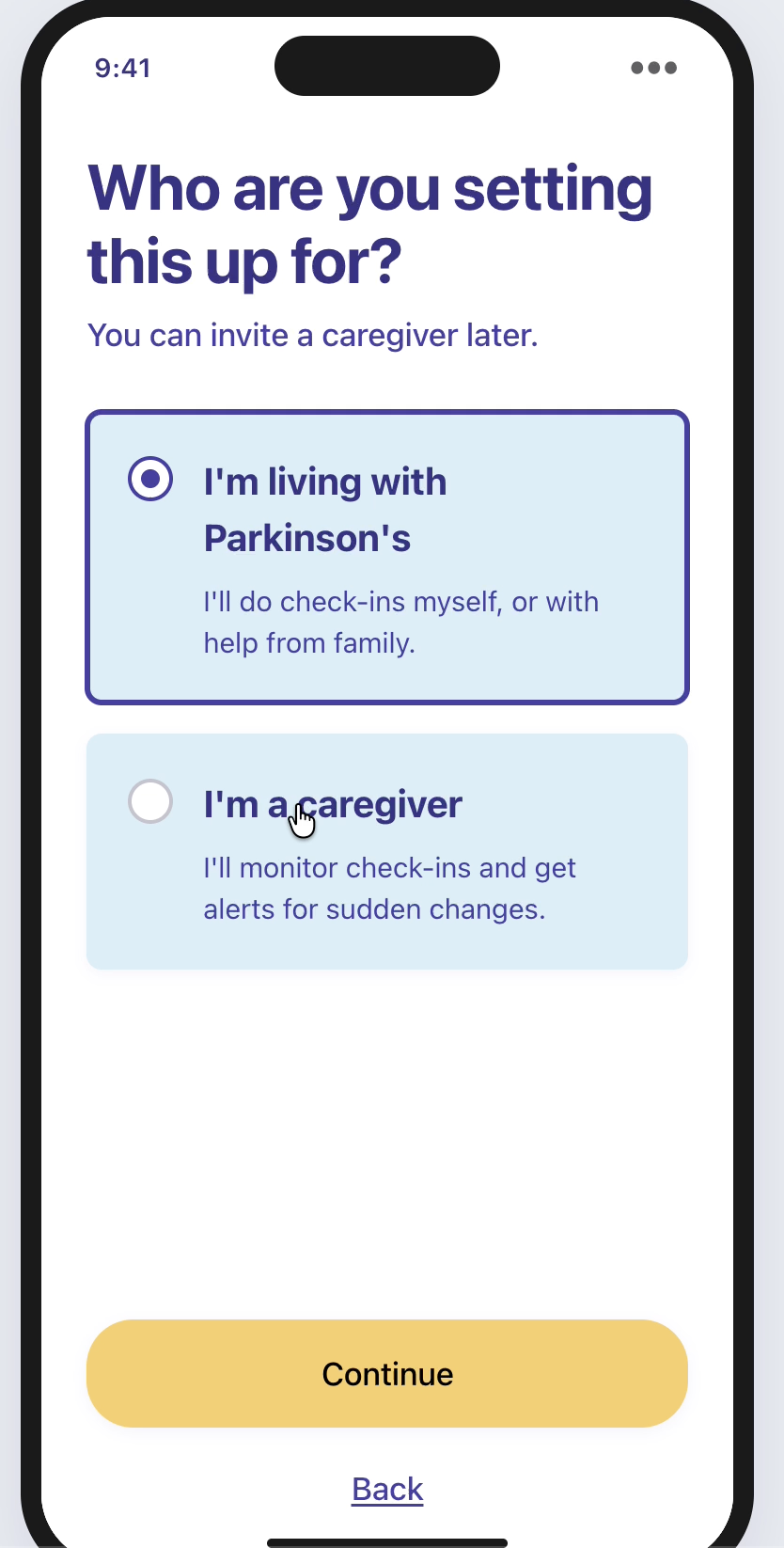
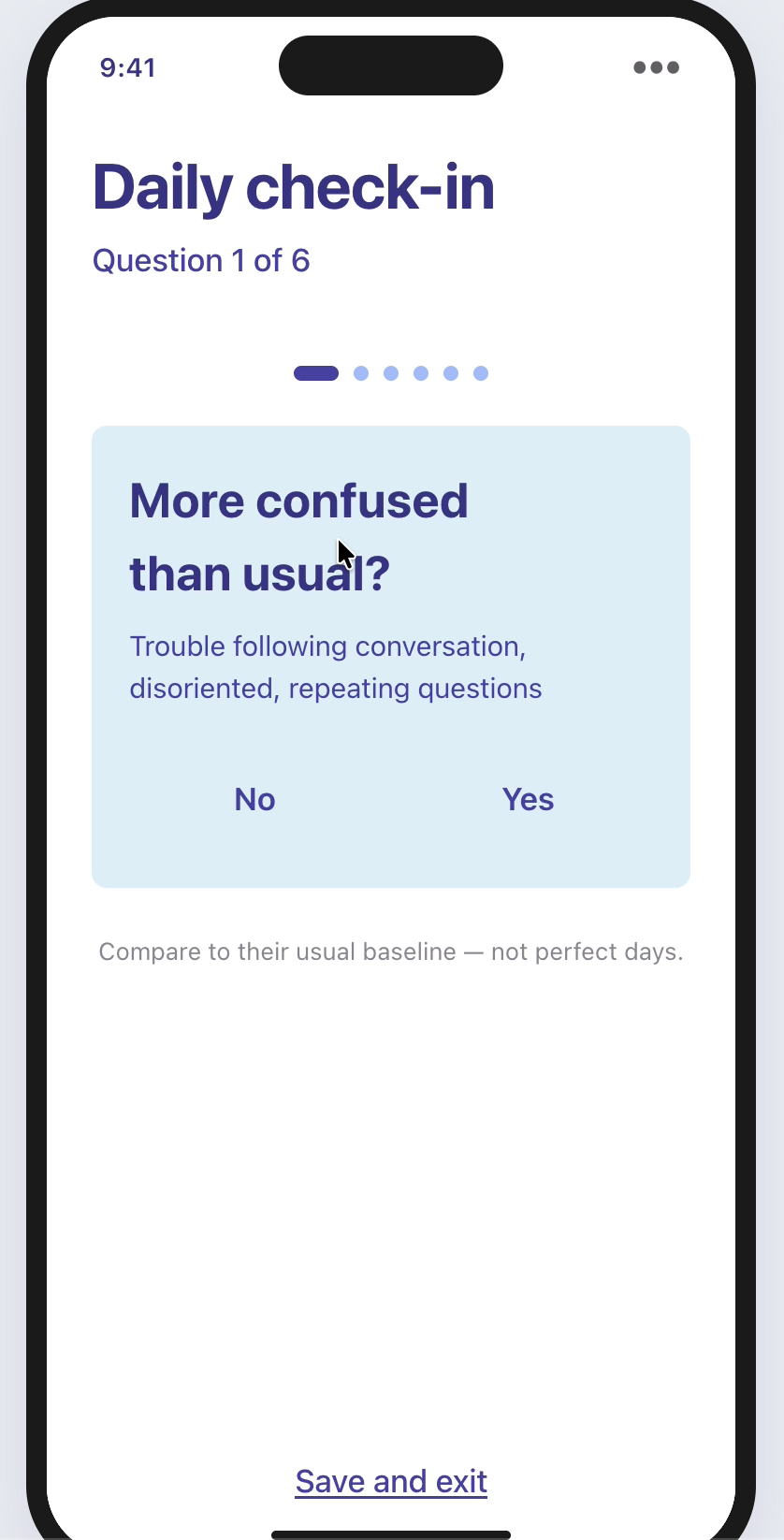
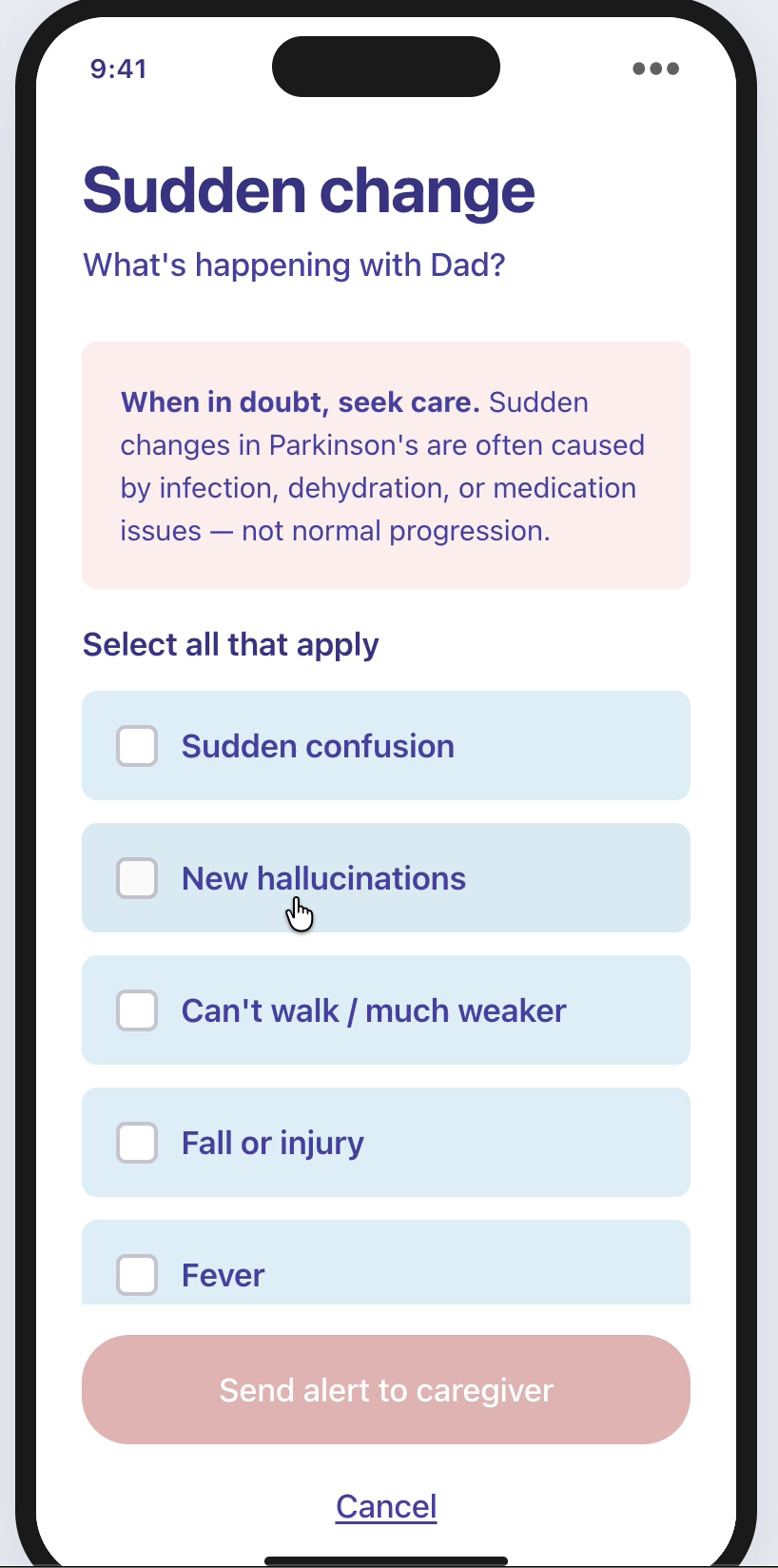
Before caregiver sessions, I built a first interactive version to make the concept tangible— role setup, daily check-in, sudden-change alert, and alert-sent confirmation. This is the product caregivers reacted to—not the polished final.
Five moderated sessions with caregivers of people with Parkinson’s challenged or refined my assumptions. The research changed who I was designing for and how the product needed to handle alerts, check-ins, and hospital information.
| What caregivers revealed | Design response |
|---|---|
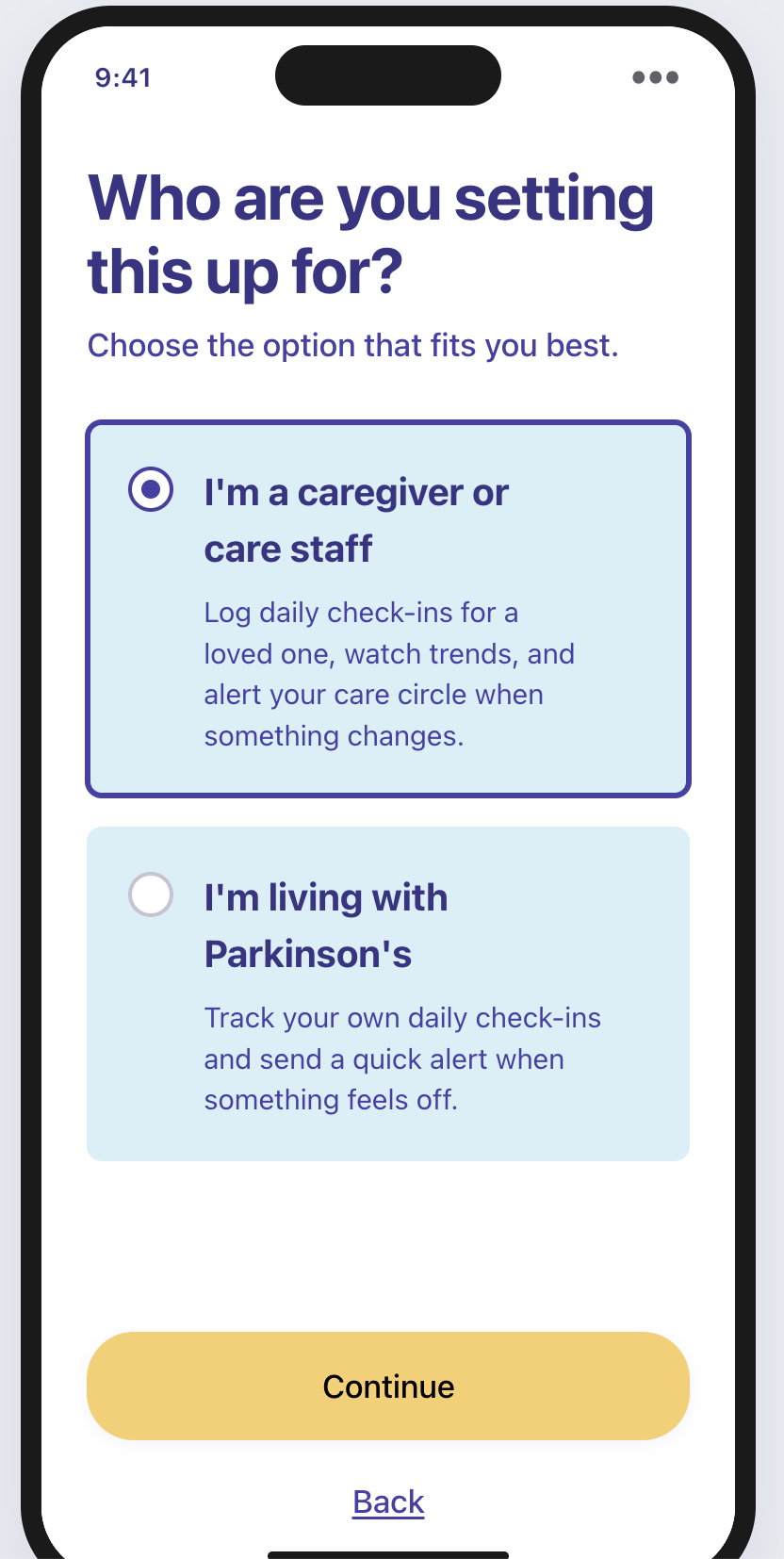
| Caregiver / care staff is often the primary user—patients may not be smartphone-capable. | Shifted positioning and flows toward caregiver-first use. |
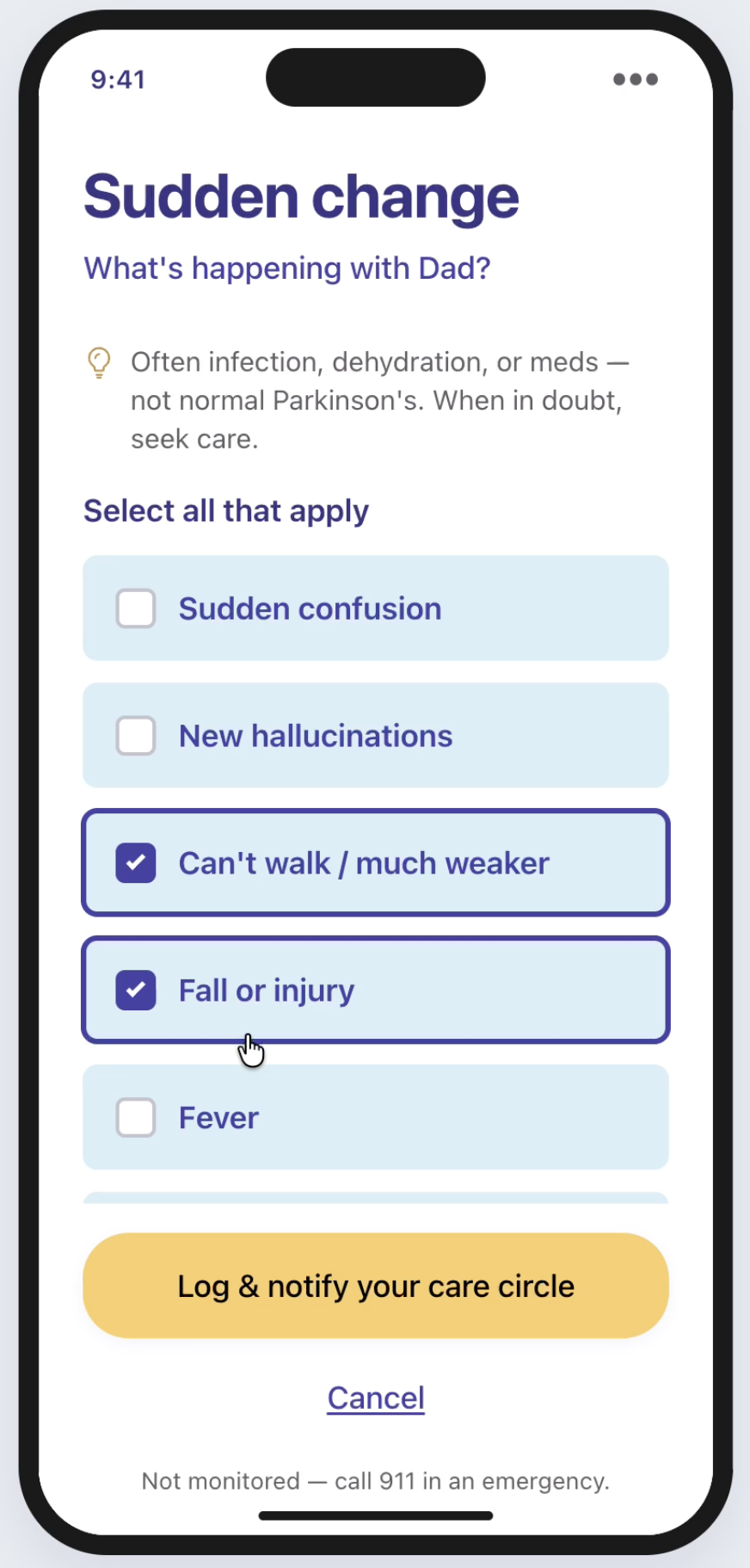
| “Notify care team” was ambiguous—who gets it, when, wait vs call 911, expected response. | Clarified recipient, timing, and expected response in the alert path. |
| Multiple people may share care responsibilities. | Introduced a care-circle / decision-maker model. |
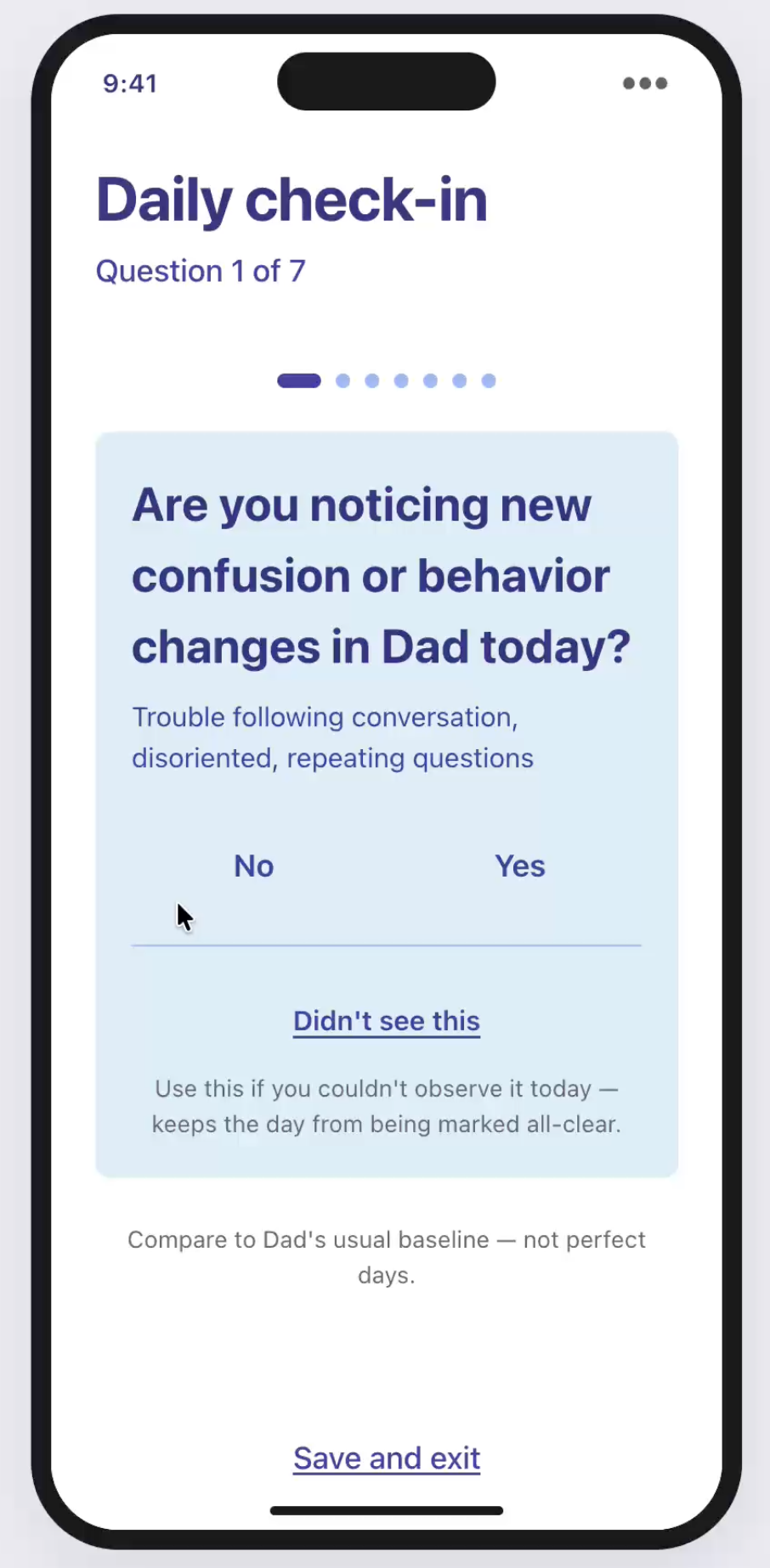
| Some symptoms can’t reliably be observed in the moment. | Added “Didn't see this” to check-ins so forced yes/no doesn’t create bad data. |
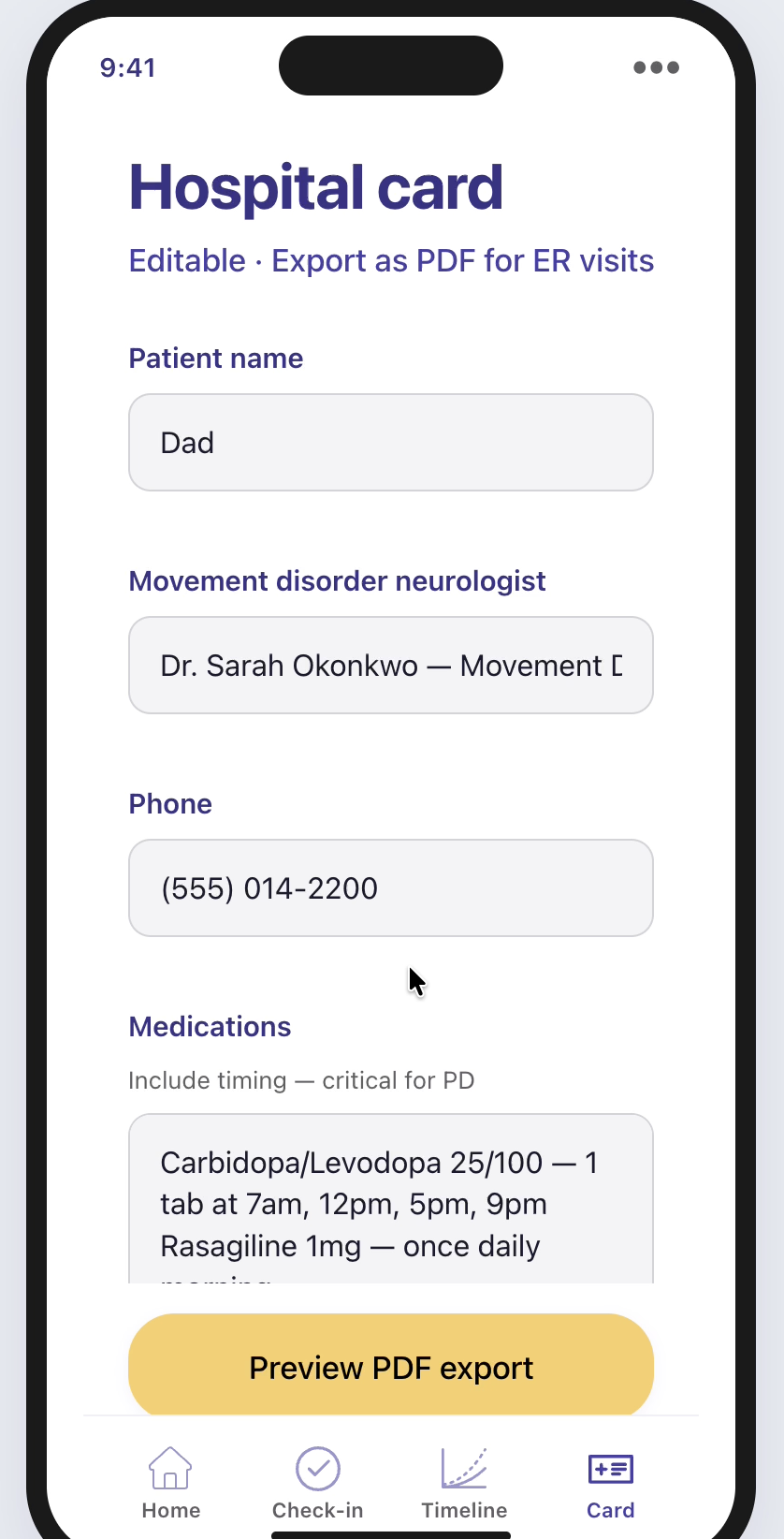
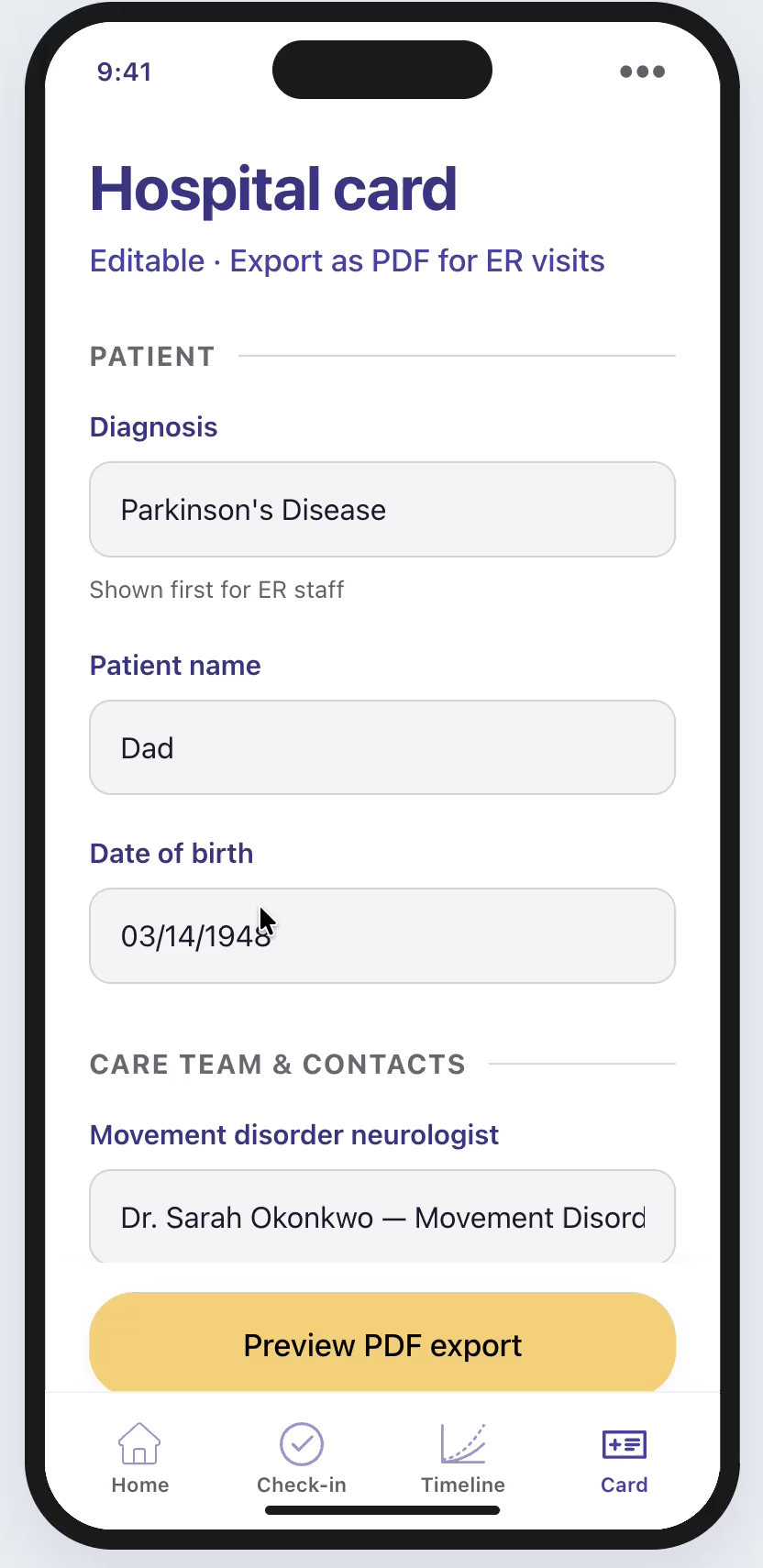
| Hospital card information wasn’t sufficiently discoverable in a crisis. | Improved card hierarchy/content and surfaced critical information. |
| Privacy / clinical credibility affect whether people would trust the product. | Recommendation for next iteration — stronger HIPAA/privacy messaging and clinical credibility cues; not fully redesigned in this pass. |
Findings from the sessions drove a redesign pass: caregiver-first framing, clearer alert routing, care-circle structure, “Didn't see this” on check-ins, and a more scannable hospital card. Below is the arc—before research → after redesign.
Explore the interactive prototype: faybebe.github.io/ClearSignal
Not a medical device. For logging and care coordination only—does not diagnose, treat, or replace clinical judgment.